


Christmas is approaching and you have no idea how many feet of lights for a 7 foot tree are enough?
Without lights, the festivity of the season is incomplete.
Christmas tree decoration is the most exciting activity for both children and adults.
Lights hold meaning and relevance in such festivals to bring positivity back into your life.
These lights come in different varieties for different lengths of trees.
With few lights, the trees look duller, and with dense lights, they look overburdened.
Not only at festivals but also for the exterior, tree lights create a focal point that looks modern and stunning for your space.
I am going to discuss about the factors affecting lightning and essential tips for perfect installation.
How many feet of lights for a 7 foot tree are required?
And which type of light is to be used?
Are basic questions before decoration.
You should read ahead to learn more about it.
How Many Feet of Lights for a 7 foot tree?
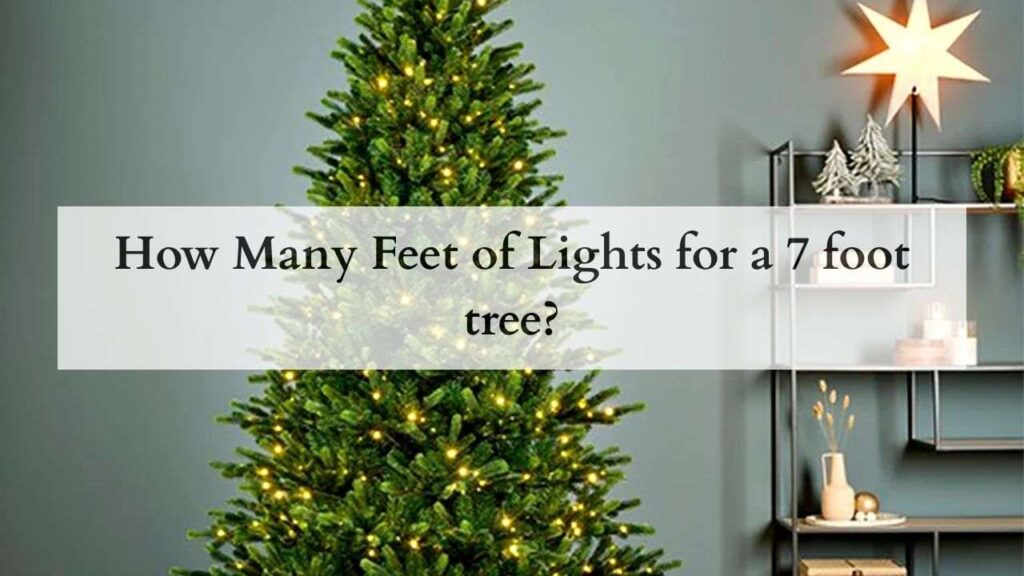
The 7-foot tree is meant to be covered by a standardised rule for lightning.
You must use 100 lights per foot to achieve a vibrant appearance.
For a 7 foot tree, the 7 strings of 100 lights each must be used on the tree for a professional look. Each strand of the light must be around 25 feet to weave in depth on trees.
Another question for the length of lights is How many strands of lights for a 7.5 foot tree?
If you are deciding on hanging lights on a 7.5-foot tree, then I have gone through one of the comments of a reddit user. He stated, “My 7.5ft tree looks pretty good with 800 (400×2)”.
He meant that his tree looked good enough with 800 lights.
He miscalculated earlier as the corner tree couldn’t be covered in 600 lights.
To make your tree look better, I have prepared a table with all the possible heights of the trees to ease your problem.
You may find it difficult to figure out the number of lights elsewhere.
The standard rule of lightning is the height of the tree × 100 lights each.
| Height of the tree | For subtle/minimal | For a standard look | For vibrant/dazzling |
| 5 Ft | 500 lights | 700-800 lights | Over 900 lights |
| 6 Ft | 600 lights | 800-900 lights | Over 1200 lights |
| 7 Ft | 700 lights | 1000-1100 lights | Over 1400 lights |
| 7.5 Ft | 700-800 lights | 1100 lights on average | Around 1450-1500 lights |
| 8 Ft | 800 lights | 1200 lights | Over 1600 lights |
| 9 Ft | 900 lights | 1400 lights | Over 1800 lights |
The table continues at the significant height of the tree.
The number of lights determines the area of the tree being illuminated.
They enhance the curb appeal of the property and increase property value for the better.
The recommended number of light counts below is based on the average tree density.
The extra details can be included regardless of the table here.
Based on the above mentioned height of the trees, this table is framed carefully to enhance the visual appeal of the festive trees and exterior greenery.
| Light count (approx) | Length of light string | Style of lighting | Wrapping style | Best use for |
| 300-400 lights | 250-300 ft | Minimal and subtle lighting | The loose wraps are visible coverage with 4-6 inches of spacing | It minimises the dark spots and improves depth/symmetry for your small room or tree. |
| 400-600 lights | 350-450 ft | Balanced and classic lighting | Moderate wraps with 2-3 inches spacing for better coverage | It is better for houses and festivals. It also serves a balanced look. |
| 600-800 lights | 550-650 ft | Full and bright lighting | The medium wrap with consistent 2-3 inches of spacing for a grand look | It makes the space like winter wonderland and super sparkling |
| 900-1000 lights | 750-900 ft | Heavy, professional and luxurious lighting | The dense wraps that are 1-2 inches apart from each other | Used in exteriors to highlight the features of the house and the outdoor trees. |
| 1000+ lights | 1000+ ft | Extra sparkly and bold commercial lighting | The dense wraps with no spacing | Used in showrooms and malls for display to attract customers easily. |
The table can be applied in the landscaping of the interior and exterior of your house.
The height of the tree is equivalent to the height of the wall for the light count.
You can decide the light counts on your desired appearance.
Essential Guidance For A 7 Foot Tree Lightning
For a beautiful and alluring lighting of the tree, it is essential to have guidance for a 7 foot tree with common mistakes you must avoid.
Some tips are stated below that can enhance the visual interest for the viewers.
You should take them seriously to achieve perfection in your decoration.
Tree Width And Density
The lighting depends mainly on the length and the density of the tree.
From the exact dimensions of the tree, you can easily calculate the light count and the number of light strands required for the installation.
The more density there is, the more extra lights you’ll need.
If the tree width is miscalculated, then there is a chance you can unsee the blind spot that leads to the imperfection in the appearance.
You can also overburden the tree with lights that you must avoid to achieve the alluring lighting.
Proper Light Spacing
The proper light spacing is necessary to build a consistency of lighting.
It plays an important role in the grandeur of the trees.
The spacing is important for the tree’s health and reduces the damage done by providing support to the branches.
It gives texture to the trees and creates a sense of harmony among tree and the decor.
This contributes to the illusion of extra space in your house or exterior.
The balanced lighting uplifts the energy and prevents branches from burning or breaking.
Dense lighting damages the trunk and makes it brittle, which concerns the safety issue.
Always Have Extra Lights
You must keep extra lights before installation to prevent repurchasing.
Sometimes, the calculation of the light strands does not complement the appearance well.
You must have extra material to hang around the tree and the walls. It saves time and extra effort.
When any light bulb gets a fuse, you can change it instantly without having to buy a new one every time.
Extra material also gives you a chance to flex your creative side and can prevent daisy-chain hazards.
You can create enchanting visuals and improve the charm of the trees.
Use Tools To Prevent Tangling And Proper Switches
It is necessary to use proper switches for direct connection to prevent shock circuiting or tangling of the lights.
People also use anti-tangling tools while having the lights on the tree.
It allows the light to stay in one spot only and make fewer movements.
If the lights are hung structurally, then you can also alter their position according to the height of the tree.
The properly structured lighting offers an aesthetic appearance that adds to the beauty of the tree landscaping.
Types Of Lights And How They Are Useful
There are many types of lights to be put on the trees, but they all come in distinctive features.
The right choice of light will cover the most space on your tree.
The most commonly used lights for Christmas trees and outdoor trees are listed below.
You can explore the other options for consideration of a better choice.
Fairy Lights V/S Cluster Lights
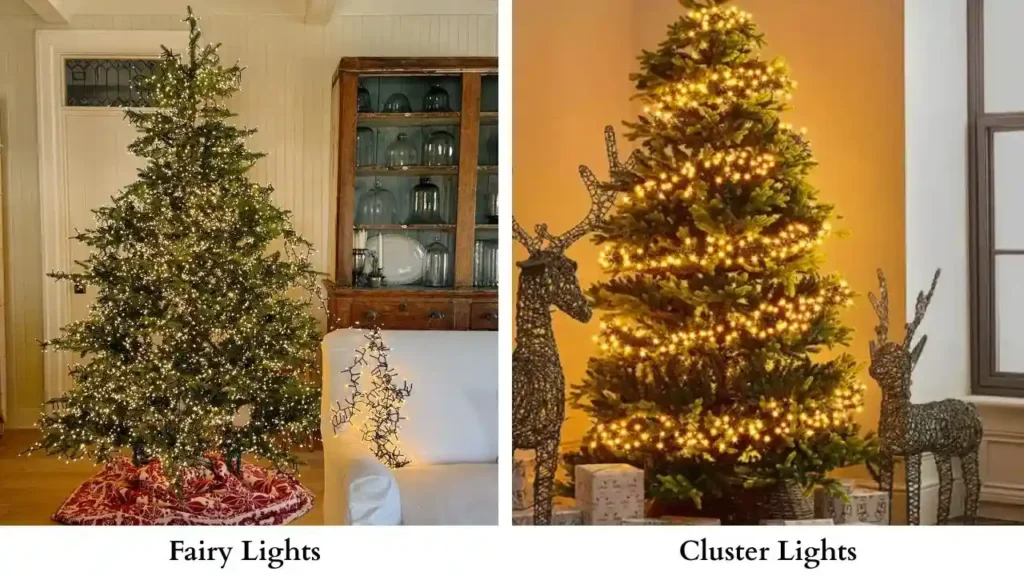
Fairy lights are small bulbs on pliable copper or green thin wire that can be easily put on any surface.
It offers an enchanting firefly effect on your Christmas tree.
They have wider spacing that takes up a larger space.
It is space-efficient and is available at affordable prices.
It is especially popular for the invisible string effect.
It enhances the aesthetics of the space and comes in warm-white, multicoloured, and 8-mode flashing for distant looks.
Cluster lights are dense LED lights which look like a curtain majorly.
It gives a dazzling effect, unlike the fairy lights.
They can be used on any size of tree or any building.
It is used for festive decorations and lasts longer from Easter to the New Year.
They are energy-efficient and illuminate densely, covering a large space of the tree.
It has more than 8 modes that illuminate outdoor and indoors.
You can hang them easily, too, as they are versatile.
LED Lights V/S Incandescent Mini Lights
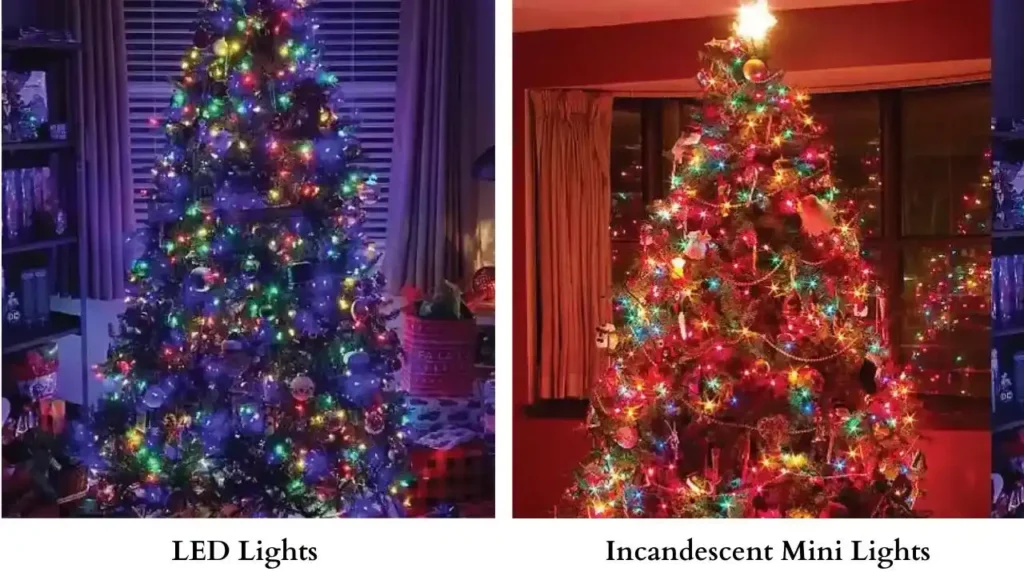
LED lights are the first choice of the modern generation as they are available in numerous colours.
You can control them from your mobile and also change the modes easily.
It is durable and versatile, which makes it stronger than other lights.
It also ensures safety measures like a cooling effect for the excessive warmth and auto-control the voltage without affecting the power of the lights.
Incandescent mini lights are the vintage option of the LED.
They often get warm and last less than LED, but it offers a nostalgic and subtle homely feeling.
They are suitable for outdoor landscaping as they have a system that still works even if one of the bulbs breaks.
It is also available in multiple colours.
The inner side of the glass is painted to reflect the colours outside for the vision.
Vintage Lights V/S Solar Or Smart Colour-Changing Lights
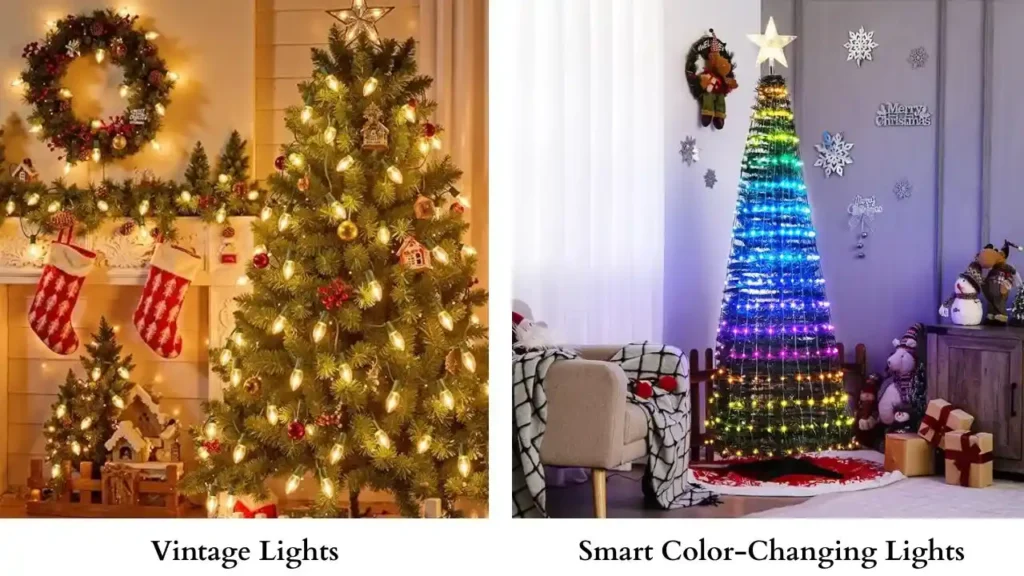
Vintage lights include C7 and C9 bulbs, which are used indoors and outdoors, respectively.
They are bright and remind one highly of the 1900s era.
These bulbs are shaped in the authentic shape that eventually serves a bold appearance for your house.
It also includes the ceramic-painted lights, which look aesthetic and warm.
They are opaque and eventually reminiscent of mid-century trees.
The bubble lights and triple-dipped lights are a beautiful decoration of the 1950s.
There’s nothing better than vintage.
Solar or smart colour-changing lights are a modern decoration that can be managed through a phone and last longer.
They save 90% of the energy and stay cooler.
It is a good option as they are eco-friendly and give endless options of colours.
They illuminate brightly and can be used with versatility.
They both are durable and can be customised, but they both come with limitations.
Solar lights work only when the sun is high, and smart lights work until they are charged with electricity.
Yet, it is one of the best options for trees during the festive season.
Smart Guide For The Light Installation After Calculating How Many Feet of Lights for A 7 Foot Tree
After deciding on the light count and the height of the tree, you must learn the proper installation of the lights to achieve the desired look.
The installation works directly in favour of the visual appeal of the tree.
The better the installation of light is, the more inviting it appears.
This guide offers the main steps of the installation precisely for a neat and magnetic appearance.
Step 1: Check all the strands of lights before installation – you must check the lights many times before hanging them on the tree to avoid rearrangements.
Proper installation ensures balanced and neat lighting.
Step 2: Start from the top and go downwards by each strand- the lights should be woven from the top of the tree to the bottom.
It covers every dark spot of the tree, and the spacing can be handled accurately.
Step 3: Choose the wrapping style- there are two kinds of wrapping, vertical and horizontal wrapping.
They both are done depending on the size and the density of the tree.
Vertical wrapping starts from the top of the tree and moves downward, whereas horizontal wrapping starts from the trunk of the tree in concentric circles for a fuller and deeper look.
Step 4: Make the closure at the end to continue wrapping- After wrapping the tree, you must make a closure at the end, then continue on the next light strand from there to give a consistent appearance.
You must start from the same spot where the light stopped wrapping.
They are the basic steps of the light installation, but lights are available in a wide variety.
You must know the type of your lights to prepare for the proper installation.
This is the guide based especially on a 7 foot tree, but it can be applied easily to any length.
Major Factors That Affect Lightning On The Tree
The lightning on the Christmas tree should be bright and dazzling.
It can be managed if the major factors are properly regulated.
Numerous minor factors for lightning make your descent space appear congested and unfulfilling.
Here, the major factors that affect lightning on the tree are listed below to make them appear balanced and elegant.
Tree Types And Their Density That Affect How Many Feet of Lights for a 7 Foot Tree
The trees can be slim, pencil or dense, having different densities.
Any tree can be decorated, but for Christmas, people decorate a fir or a pine tree.
To determine the length of the lights, you should be aware of the tree type.
The Christmas tree variety includes fir, pine, and spruce, as they are strong and have excellent weight-bearing ability.
Meanwhile, the exterior tree variety includes palm trees, maples, and boxwoods as they are perennial and low-maintenance.
The density of such trees decides how many feet of light strands will be required for decoration.
Decorative Preferences
The wrapping preference gives an appearance to the tree.
It also determines if the look will be subtle, balanced, or luxurious.
The main wrapping styles are vertical and horizontal.
They cover the lights in a manner so that there is no blind spot.
The perfect decoration makes an illusion of a larger space.
On the contrary, the incomplete decoration preference makes your space look messy and unbalanced.
This factor can solely ruin the lightning of your house.
The wrapping of the light decides the final look of the tree.
Placement Of The Tree
It is important to decide on the placement of the tree. It is normal to question how many feet of Christmas lights for a 7 foot tree are needed.
If your Christmas tree is outside as an exterior feature, it can be over 7 foot that requires a large amount of lights.
If it is inside for a personal decoration, then the 7 foot tree can be positioned to bedazzled with string lights.
The lights spread in the room evenly if the tree is stood inbetween of the house.
For more sparkle, you should have a tree in the focal point of your house or yard.
These factors should be considered for perfect lighting in your house.
They are applicable in the placement of christmas trees, including the exterior.
Lights are carefully hung as they give style and character to the house.
Conclusion
Now that you have read thoroughly about how many feet of lights for a 7 ft tree are required.
The kind of light and the major factors that directly impact the appearance of the tree should not be overlooked.
If you want to make your space welcoming and cosy just by using lights, then it is a perfect spot for you.
The light count calculation is already done above to help you choose the exact materials.
The Christmas tree and the exterior trees are decorated using lights and decorative items to make them look appealing.
There are several types of lights, like fairy lights, cluster lights and vintage lights.
Each kind is popular for its own charm that is valued only when it is hung right, enhancing the verdure of the tree foliage.
The length of the light should be chosen correctly with the relevant light count for an elegant landscape.
FAQs on How Many Feet Of Lights For A 7 Foot Tree
Ans. The lights should be 150 to 200 ft, consisting of almost 700-900 lights with at least 5 bulbs per foot for a 7 ft tree. You should analyse the height and density of the tree before calculating the length of the lights for any tree.
Ans. Yes, 1000 cluster lights are enough for a 7 ft tree. It will cover the tree entirely without leaving a blind spot and illuminate the space entirely. If you like a vibrant and dense look, then 1000 cluster lights are more than enough for a 7 ft tree.
Ans. 7-8 strands of the lights are needed for a 7 foot tree. The standardised lighting look can be achieved by using 100 light count per foot. It progressively increases in number if you want 7 foot tree to be moderate or sparkling.
Ans. Electricity outage and voltage burden are the main cause an entire string of Christmas lights to burn out. When the fuse is blown in the circuit, or one of the lights is shattered, it damages the whole current series of lights. It leads an entire string of Christmas lights to burn out.