


One of my dearest friends owns a poultry farm in the countryside, so he often buys domestic hens. Whenever I visit him, I often confuse a light brahma hen vs rooster.
They look almost identical due to their physical appearance. I have spent a long time with my uncle to understand the key difference between them for you.
At first sight, it is hard to tell whether it is light brahma hen or rooster, yet there are differences which set them apart in the flock. A light Brahma hen is an asian chicken in small size that has a soft appearance with uniformly sized feathers.
On the contrary, a rooster is large, loud and is known for its long tail and saddle feathers on its striking body. Their behaviour, temperament, role and appearance vary in comparison.
In this guide, I will let you know about the Light Brahma Hen Vs Rooster comparison, which will help you as you go to buy a hen or a rooster for your farm. Understanding their differences will guide you through the journey of egg production or other activities.
What Is A Light Brahma Hen?
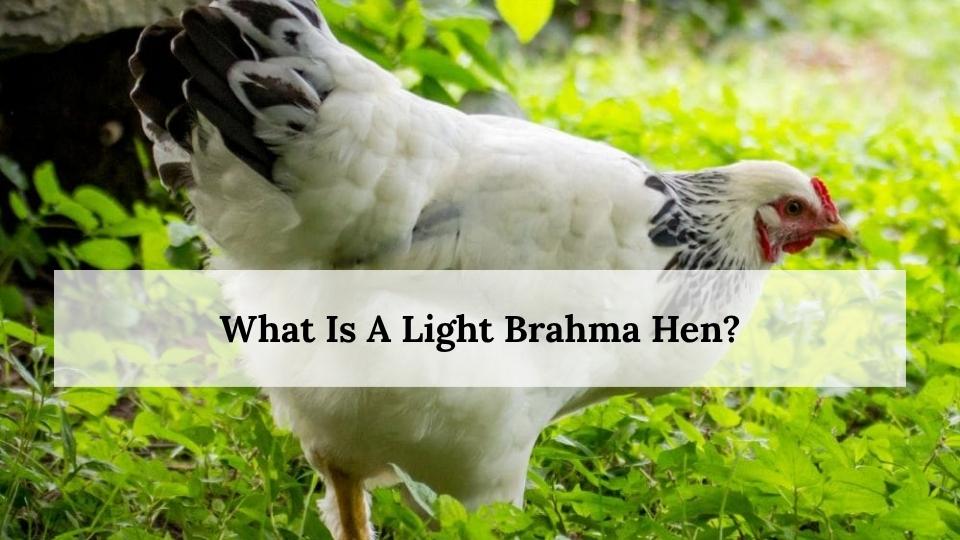
A Light Brahma Hen is popular for its small size and soft feathers. They have a short tail that makes them look simple and clean. Brahma Hen is easy to handle even on busy working days. They rarely get aggressive and are mostly friendly with humans and other animals.
Being a hen, they lay eggs regularly, at least 150-200 every year and raise them to be like them as they run around the farm clucking. Hens are calm and gentle with others as they lead in quiet flocks.
You can find them in other colours like Buff and dark colours. They are one of the largest chicken breeds in the world, with a noticeable weight of 8-9.5 lbs. Light brahma hens are devoted mothers who take care of their chicks.
Yet, when it comes to themselves, they are the least influenced by weather changes. These peaceful hens make a peaceful coop that even a beginner could handle easily.
What Is A Light Brahma Rooster?
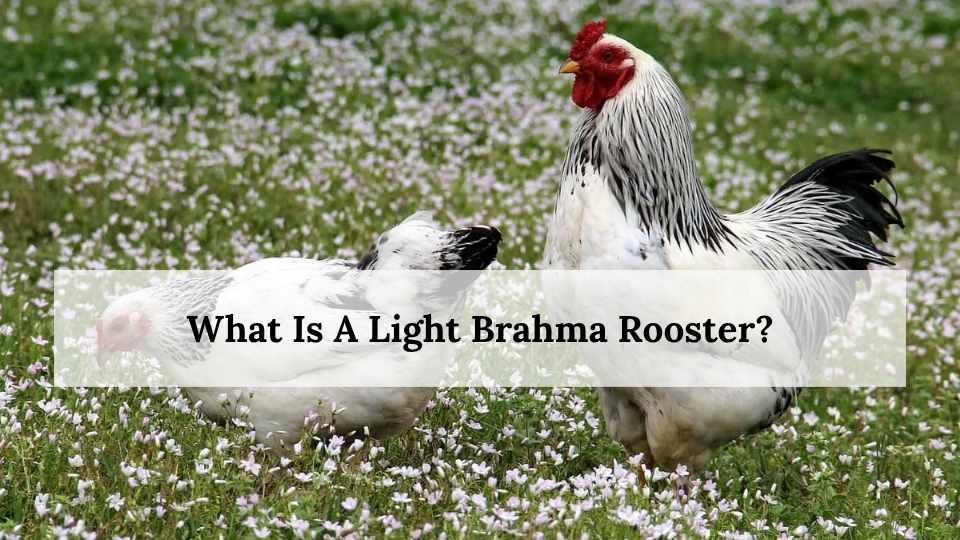
A Light Brahma rooster has a striking physique with a large body that weighs 10-12 lbs. At a closer look, it also has a long tail and saddle feathers on a tall upright body. You will find them in various colours like buff and dark.
They are the dominant breed of the farm that protects hens from danger with their loud crowing. Roosters are used for breeding and attract their mate by showing their feathers.
They have moderate aggression that can be territorial in various conditions, which makes them a hard-to-raise breed.
If you also want to raise a rooster with a hen, then get ready for their behaviour. It acts as a leader of the flock that needs proper attention and careful handling. You should be experienced enough to raise them with their commanding nature.
They are also intelligent in nature and react to expected threats to save themselves and their flock. You can put them in your farms but they are the best fit for rural settings and breeders.
Key Differences Of Light Brahma Hen And Rooster
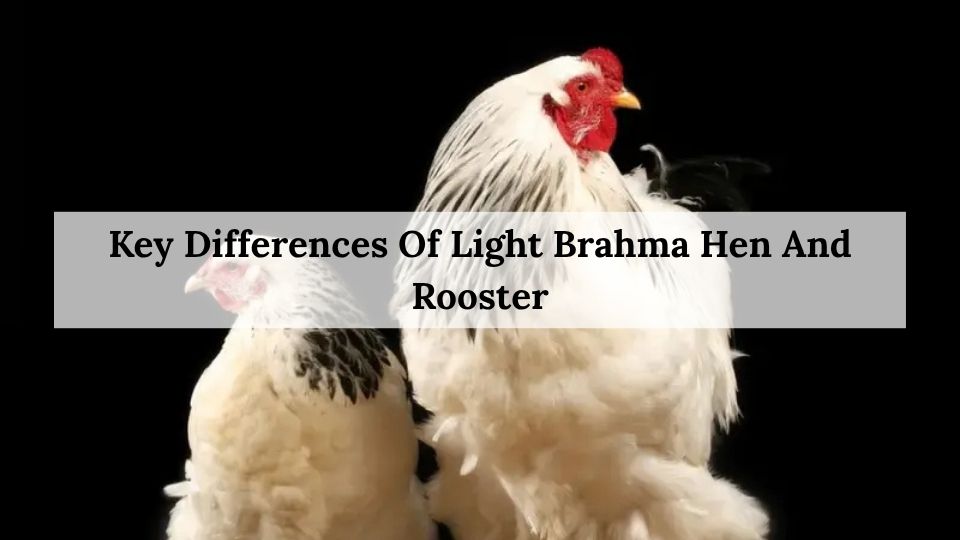
It is necessary to understand the primary differences of Light Brahma Hen vs Rooster to decide on the best.
Maybe you will be able to keep both of them in the same flock of your farm but they are two distinctive genders of the same Brahma species with unique behaviour and temperament. Here, I have discussed the differences below to make it easy for you to choose.
Origin
Light Brahma hens and roosters come from an ancestry of large asian chickens from the Brahmaputra region. Yet, they are developed in the United States for luscious meat and eggs.
These chickens belong to the same species, light Brahma, but gender and behaviour differences set them apart from each other.
A hen is female and a rooster is male gender for the Light Brahma species. Their main differences lie in their roles and impacts on the farm.
Physical Build
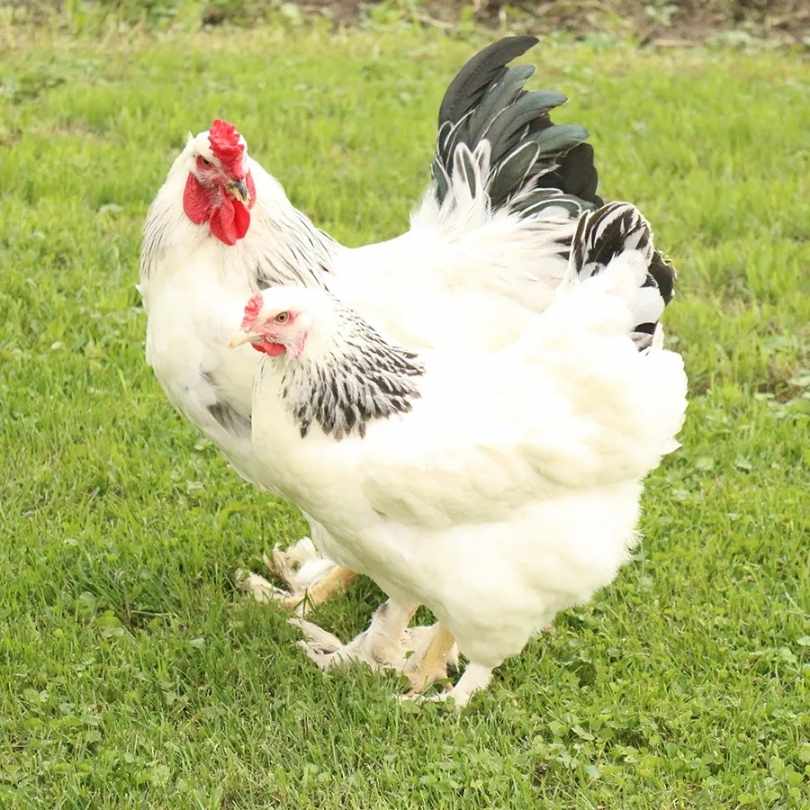
Light Brahma chicken hen vs rooster, both have a distinctive physique due to gender differences.
Light Brahma hens are smaller in size, weighing 8-10 lbs with a round and compact body standing on thick and small legs, which is suitable for small poultry farms.
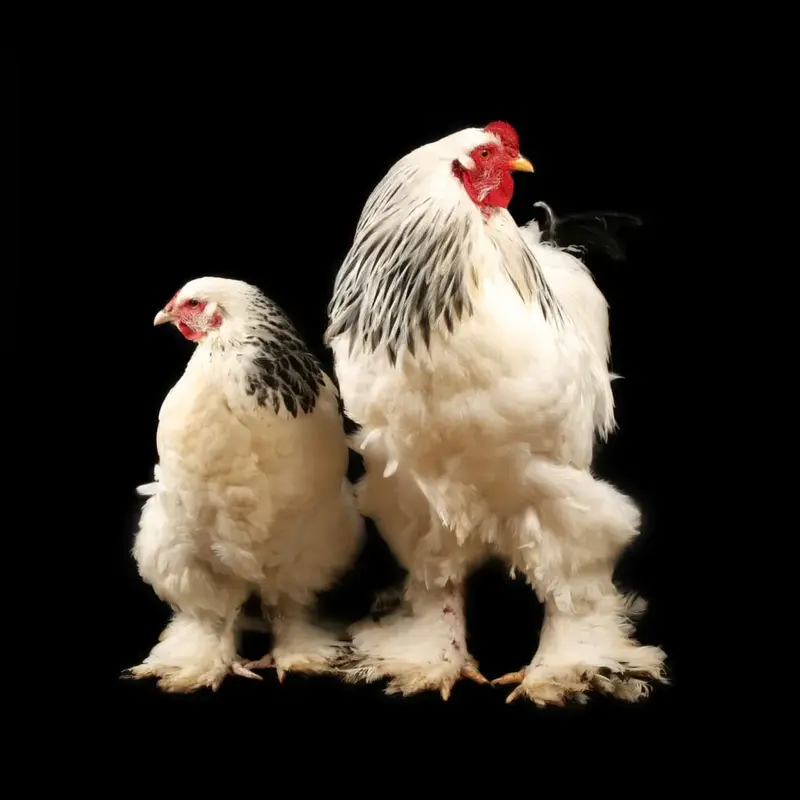
On the other side, a light Brahma rooster size is larger, weighing 10-12 lbs with an upright, muscular striking body. Even their legs are thicker and stronger, which look decorative and bold.
Feathers
Light brahma hen and rooster both have a huge difference in their bodily and tail feathers. They may look the same at first glance, but hen’s feathers are in a uniform pattern and even colour.
They are less shiny and give insulation to their body in winter. Feathers around their neck are short but rounded at the end, yet at the saddle, you will not even find any at all or very minimal. Their tails have short feathers, are stiff, and have practical purposes.
In the case of Rooster, they have long and glossy feathers, complementing their striking appearance with pointed and flowing feathers on the tail. It is their decorative feature that shows dominance and elegance.
Comb And Wattles
Their pea comb may look similar but they have completely different sizes, functions, and colours. If you look at Hen’s comb, it is small in size, stays flat and subtle. Moreover, the rooster’s comb is large and in the same shape, yet it looks more enhanced and beautiful.
Now, the wattles of a hen are small and compact, which keep them warm and help with the duration of pregnancy, but the larger, fuller, bright red wattle of a rooster helps them attract hens for mating.
Behaviour
When we compare their behaviour, hens are the opposite of roosters. Hens are calm and tender. Even when they make sounds, it is a quiet clucking for cooperation with others.
With humans, they are easy to handle as they have no aggression at all. On the other side, Roosters have a dominant behaviour and they protect their area with loud crowing as a responsible leader. Their alertness is high, which keeps them watchful and cautious for any threat.
Growth and Development
The growth of a hen is steady and slow, which makes their maturity age over 6-7 months. During those days, they began laying eggs as their bodies evolved. Feathers grow rounder and more uniform with the slow development of a comb on their head.
If we shift our focus to Brahma Rooster size, they grow faster and even their combs grow larger within the next 4-6 months after birth. Their feathers grow decorative and pointed, which they later use to attract mates.
| Basis | Light Brahma Hen | Light Brahma Rooster |
| Origin | United States | United States |
| Physical build | Smaller and rounder, with a weight of 8-10 lbs | Larger and muscular, with a weight of 10-12 lbs |
| Feathers | Rounded and uniform, with a blunt surface | Larger and pointed that looks glossy and decorative |
| Comb and wattles | Small and compact comb with flat wattle | Large comb with beautiful wattle to attract hens for mating |
| Behaviour | Calm and gentle, it makes a quiet clucking sound. friendly behaviour with humans | Loud crowing, dominant behaviour and highly cautious protective behaviour |
| Growth and Development | Grows slowly and mature by next 6-7 months after birth. | Grows faster in the next 4-6 months with an attractive physique |
Which One Should You Choose?
Light Brahma Hen or Rooster both play an important role in farms, which benefits others. They are used for various tasks, such as breeding, for meat, for egg production and for protection.
With the difference in their characteristics, it is hard to choose which one is better for which work. To understand the correct use of hen or rooster, I have discussed below the prime choices for these activities.
Egg Production
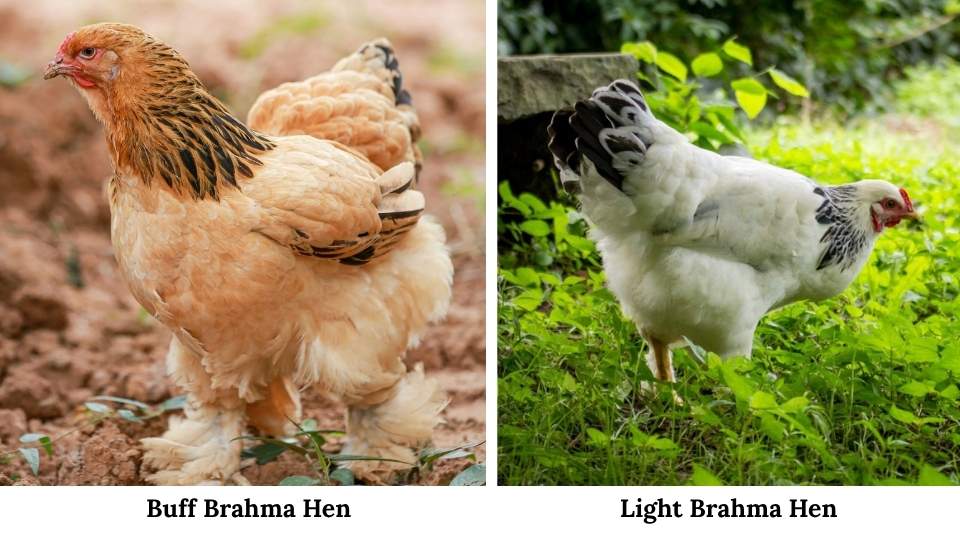
Primarily, light brahma hens lay eggs, which contribute highly to egg production but when we talk about egg production, buff brahma hens are superior. It sometimes causes a great comparison between buff brahma hens vs roosters for various activities.
Buff Brahma Hens are more consistent and reliable for Egg production than Light Brahma hens. Light Brahma lays medium to large eggs but Buff Brahma lays large to extra-large eggs of high-quality nutrients.
Choosing Buff Brahma hens for egg production will be a beneficial choice as it is one of the varieties of light Brahma Hens.
On the other hand, Light Brahma roosters are genetically unable to lay eggs.
Breeding Role
Light Brahma Hen and rooster both play an important role in breeding as they are female and male, respectively. A rooster performs tibditting to attract a potential match for breeding.
When the rooster fertilises the eggs, his role finishes further but shifts to protection and maintaining order in the flock during difficult periods.
On the flip side, a hen has more motherly responsibilities in behaviour. They lay eggs and may become broody to sit on eggs for at least 21 days until it cracks open.
The light brahma egg colour is light brown, which is prone to cold, so they keep them warm and safe. After the younglings are born, it is their duty to feed and teach them survival skills as a mother.
If you are planning to breed them, then make sure to balance the rooster and hen ratio. The large number of roosters among hens can cause cry and hue. However, fewer roosters can lower the fertilisation rate, so you should calculate carefully for consistent breeding.
Meat Use
As for high consumption of meat, Light Brahma hens and roosters are both dual-purpose chickens. Their meat is luscious and easy to cook but there is a visible difference in their meat. In the case of Light Brahma hen, its meat is tender and soft, and is easy to cook.
With the average weight, it is a moderate amount of meat that can be used for everyday cooking. Brahma hen’s meat has mild and subtle flavours that are suitable for small family meals and quick cooking.
Furthermore, the rooster is a better option for meat.
As it has a heavy and large weight, it yields a higher amount of meat. Rooster’s meat has rich flavours, releases a strong aroma after cooking, and tastes dense and firm while eating. They are considered the best for meat production on a large scale.
Protection
Considering the size and the role of a light brahma hen, they are feeble and gentle to potential threats. Normally, they are moderately alert but if the danger approaches, they escape and hide to save themselves.
Their defence ability is minimal which makes them an easy target for wild animals. Their primary role is to take care of chicks well as a responsible mother.
Roosters are dominant in behaviour that automatically makes them the leader of a flock.
They save hens from danger by confronting and warning. When they are alert, they give warnings in loud and frequent crowing.
In the context of protection, you should raise more roosters than hens because of their constant alertness and aggressive behaviour. They protect flocks, including hens in the incubation or fertilisation process.
Key Maintenance Tips of Light Brahma Hen And Rooster
When I worked with Light Brahma hen and roosters with my friend on his farm, he used to ask me to clean their coop. It was difficult at first but later, I understood they have distinctive behaviour, health and grooming, which needs to be handled carefully.
Here, I will let you know how to maintain them for different purposes. Even as a professional, these chickens are hard to handle, so how difficult it could be for a beginner.
Space Requirement
If you want to raise a Brahma hen, then they’ll require moderate space to feel comfortable. They are not excessively active like roosters. Hens need enough space of at least 4-5 sq feet to sleep, lay eggs and sleep while also incubating them for days.
When you consider a rooster, it requires a large space to reduce its stress or aggression, which should be at least 5-6+ sq feet. For their heavy body, their shelters should be strong and comfortable as they live in them.
Cleanliness Management
To raise them healthy and strong, it is necessary to keep their environment clean and hygienic. For both Light Brahma Hen and Rooster, they should be groomed properly due to exposure to dirt. Their body and feet have feathered layers that should be cleaned.
In addition, their thick layers trap moisture and mud that will lead to potential infection or risk of mites. For cleaning purposes, you should keep them dry and clean to protect them from mites, lice, or infections.
Feeding Requirements
Feeding them properly will improve their value. The light brahma hen requires a high-protein and calcium-rich diet as they lay eggs every week. They eat greens, grains and kitchen scraps occasionally and grit for digestion.
A hen’s daily intake is at least 120-150 grams, which strengthens the core and layer of the eggs. If you want to increase the quality of the egg, then feeding a balanced diet to the rooster is important.
Their daily intake should include at least 130-170 grams for muscles and to avoid obesity.
Health Monitoring
When I began monitoring their health, I checked the quality of eggs that the hens laid. If they have weak shells, then the quantity is good or not. Sometimes, when they lay eggs excessively, they can potentially lose weight.
You should focus on the eggs and their reproductive system while monitoring their health. In the case of roosters, make sure to check their legs, fertility, comb & wattles and kidneys.
If their overall body is healthy and strong, then roosters are fit enough to be in an open field.
Temperament
Raising a hen is an easy task for everyone as they are calm and submissive. They are really friendly with humans and interact kindly. You can also leave them around kids because they are less likely to fight.
Contrarily, raising a rooster is not easy. They can be calm but more dominant and protective. If someone threatens them for a fight, they often become aggressive and act as a protector to their flocks.
In terms of temperament, you will have to handle roosters more than a hen due to their dominant and aggressive behaviour.
Light Brahma Hen Vs Rooster Reddit Review
If, as a beginner, you are deciding on getting a hen or a rooster, then knowing about them beforehand is important. I was reading a few comments on Reddit asking if getting them is a worthy choice or not. They can be aggressive and calm at the same time, which is hard to predict.
Then I came across a comment by a Reddit user stating that the best rooster I ever had was a light Brahma. Sweet, gentle, even with my toddler, a wonderful protector, and so sweet with the girls and the chicks.
The Reddit user meant that in the comparison of light brahma hen versus rooster, the rooster is the best.
As discussed above, they are calm but because of high alertness, they can be aggressive sometimes. You should be careful around them, however friendly they are.
Now that you also have a review of a Reddit user, you will be able to choose the best one without cluttering the coop or loud clucking or crowing.
Conclusion
In the end, light brahma hen vs rooster is a common comparison for beginners or experienced in poultry farms. It helps them make a distinction between the uses of hen or rooster. Both of them contribute to egg production, meat and breeding. They play their own roles that directly impact the flock.
With relation to light brahma hen versus rooster comparison, brahma hens are smaller in size with a soft body that is covered with rounded feathers. It also has a small and flat comb that fits its gentle behaviour.
Adversely, a rooster is the opposite of a hen. It has a larger body with long and beautiful feathers decorating its appearance. Their comb is large and high, which complements its royal features.
You will find them calm, but due to their aggressive nature, they can lash out at any potential threat. These features set them apart from each other, except for the gender difference.
If you are a beginner in a poultry farm like me and compare a Light Brahma Hen vs Rooster, then these key differences will help you understand them better.
With the right care and maintenance, your poultry farm will flourish and grow healthy.
FAQs on Light Brahma Hen vs Rooster
Ans. If your light brahma chicken has a soft body with rounded feathers on a short tail. Contrarily, if your brahma chicken is muscular and has a muscular body with long and pointed feathers all over its body, sophisticated with a large crown.
Ans. The cost of the light Brahma rooster is between $3 and 6 dollars for one chick. If you buy them at maturity, then they can be expensive due to better breeding qualities and exhibition-type visuals.
Ans. The rarest colour of Brahma chicken is lavender but isabel and porcelain are also considered rarest for a chicken. Such colours are caused by recessive genes, which are hard to occur in constant breeding.
Ans. A light Brahma chicken is considered a gentle giant due to their calm behaviour, which even reflects on their interaction with humans. A hen weighs 8-10 lbs and a rooster is about 10-12 lbs.