


Understanding how big a yard of concrete is can be a crucial thing when you are constructing a patio, driveway or sidewalk for your house. Although you can easily visualise a yard with pickup loads, wheelbarrow or mixer truck, yet it can be calculated in numbers for an estimated volume.
Numerically, the coverage of a yard is 27 cubic feet. It is easy to calculate the thickness of the concrete with the volume as it provides resistance to damage and cracks.
The thickness depends highly on the usage it is put into. For that, architects need to measure how big is a yard of concrete 4 inches thick, 6 inches thick and so on.
In this guide, I will help you in visualising how big a yard of concrete is, its weight measurement and its coverage. Being the most common material, there are several tips to protect the layering for decades.
You May Also Like
How Big Is A Yard Of Concrete?
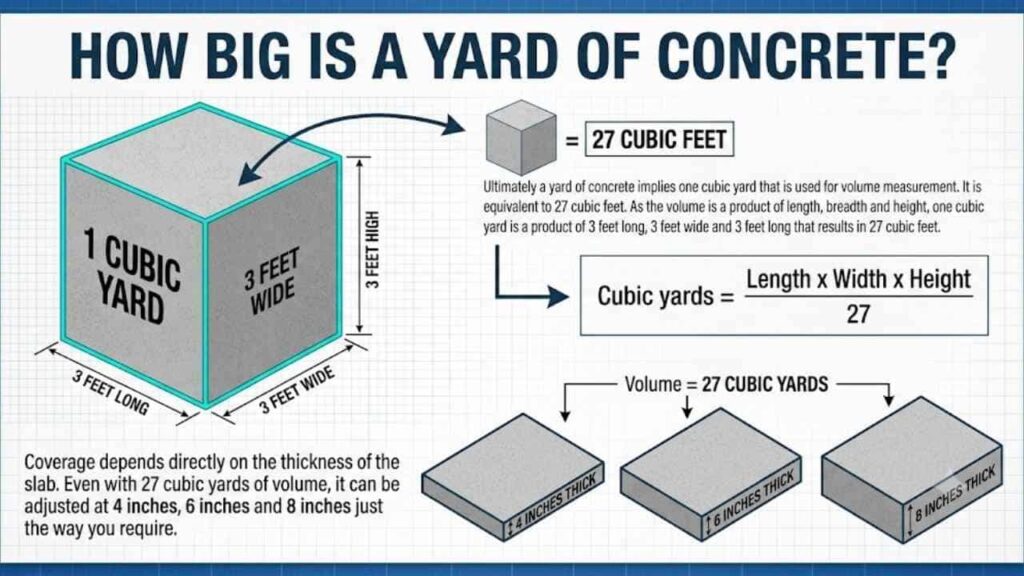
Concrete is commonly measured in cubic yard units because it helps contractors, suppliers and construction authorities with correct measurement. It is used in the construction of driveways, patios, sidewalks, slab projects and other construction projects. You can easily calculate the amount of concrete accurately.
Ultimately a yard of concrete implies one cubic yard that is used for volume measurement. It is equivalent to 27 cubic feet. As the volume is a product of length, breadth and height, one cubic yard is a product of 3 feet long, 3 feet wide and 3 feet long that results in 27 cubic feet.
To calculate how big a yard of concrete slab is in a standard unit, you need to multiply the dimensions and divide by 27 for exact cubic yards of volume.
Cubic yards = (Length × breadth × height) / 27
The coverage of the concrete depends directly on the thickness of the slab. Even with 27 cubic yards of volume, it can be adjusted at 4 inches, 6 inches and 8 inches just the way you require. With the correct usage of formula, it can be calculated easily.
How Much Does A Yard Of Concrete Weigh?
Before using the concrete over any surface, you need to check the concrete’s weight. This makes a huge difference as it needs to be transported and constantly checked for installation. It is really heavy in weight, which sometimes contractors and builders wonder while working on a yard, how much a yard of concrete weighs for their project.
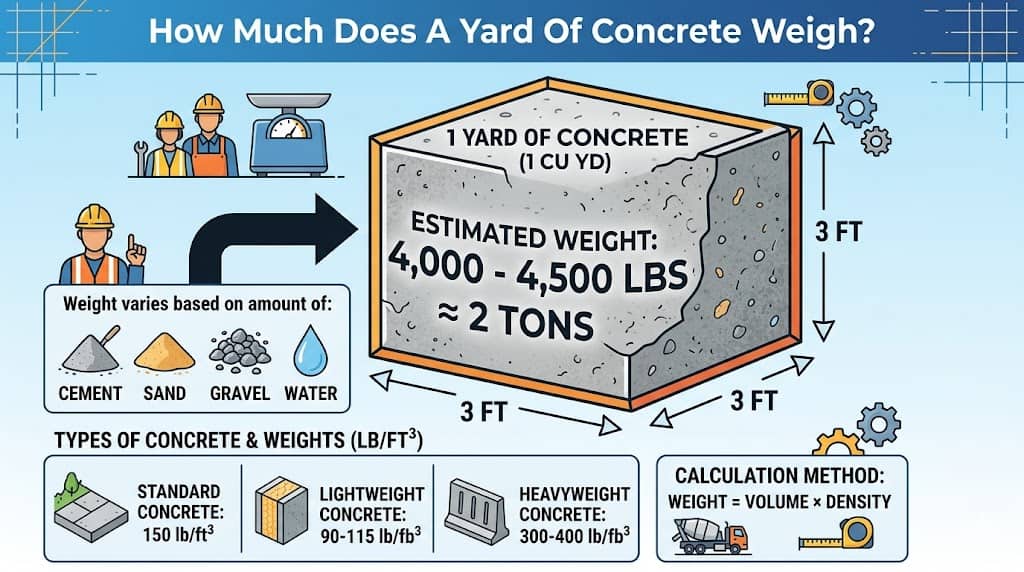
A standard yard of concrete weighs around 4000-4500 pounds, which is equivalent to two tons. The weight of the concrete varies due to the amount of cement, sand, gravel or water added.
The weight of concrete is easy to calculate by multiplying the volume and density of the concrete that results in weight.
Weight = Volume × Density
There are three types of concrete that’s weight can be different when used for several reasons. A standard concrete weighs 150 lb/ft³, lightweight concrete weighs 90-115 lb/fb³ and heavyweight concrete weighs 300-400 lb/fb³ respectively that is used in distinctive purposes.
Visualising A Yard Of Concrete
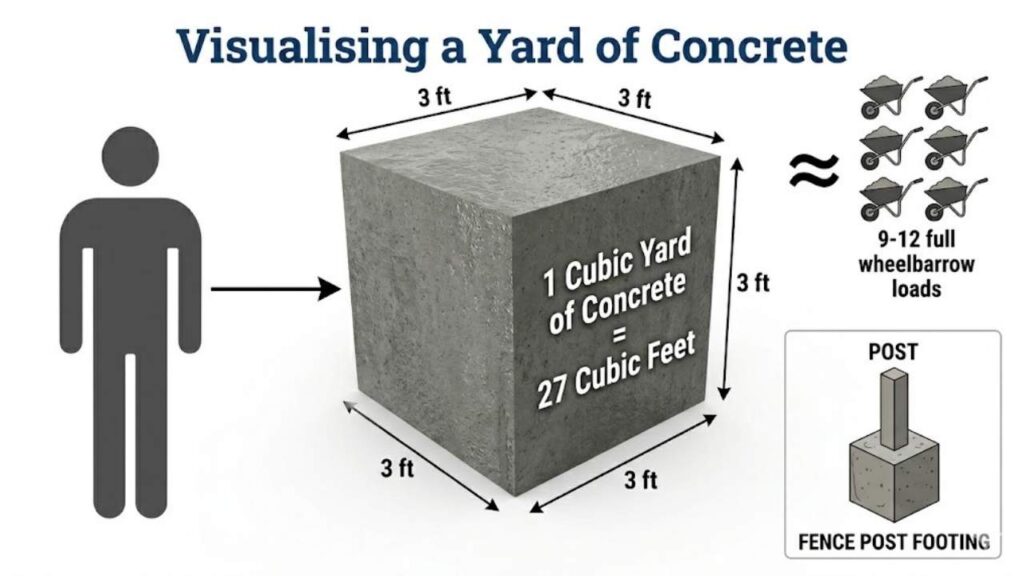
Visualising a yard of concrete based on volume is pretty much hard because it is an unrealistic measurement unit which varies according to the containers. Yet, it plays an important role in determining the size of the product, transportation and labour requirements in exact value.
We know that 1 yard of concrete = 27 cubic feet, and the number of yards are calculated by multiplying the digit to the volume. It is preferably used in small patios, driveways, sidewalks and post footings.
I shall tell you some common containers to contemplate the right quantity of concrete.
Pickup Truck
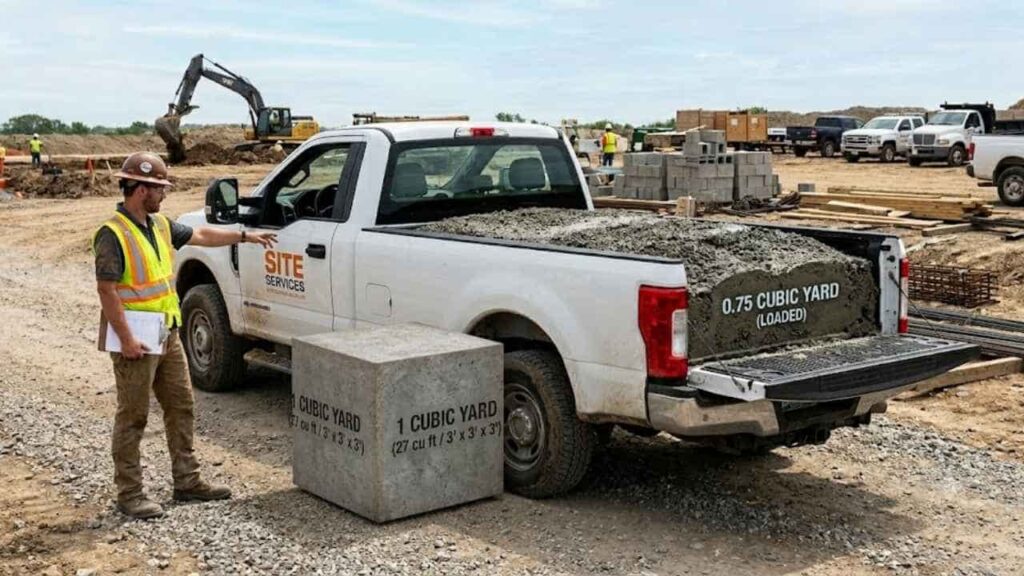
First of all, because of the heavy weight of concrete, pickup trucks are considered for transportation from one place to another. Choosing the type of truck depends on the volume of concrete that arises the question,how many yards of concrete in a truck and how much a standard-sized truck can hold.
A standard one-ton pickup truck can carry 0.75 yards of concrete. This means two tons of concrete (equivalent to 1 yard concrete) can be transported in two trips of the pickup truck.
Wheelbarrow Load
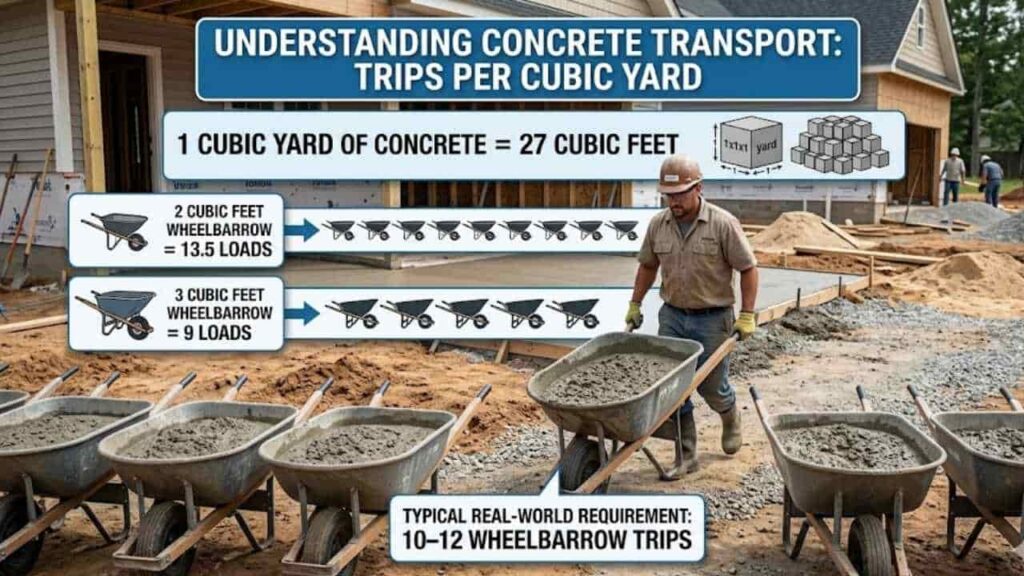
A wheelbarrow is used to transport concrete from one place to another. Usually, it can carry a load of 2-3 cubic feet of concrete within itself. In terms of load, a 2 cubic feet wheelbarrow would carry 13.5 loads, and a 3 cubic feet wheelbarrow would carry 9 loads. In real life, a yard of concrete can be carried by 10-12 wheelbarrow trips. One load will be equivalent to 200-300+ lbs, which without a loader will be a lot of physical labor.
Since one yard is 27 cubic feet in volume.
27÷3 = 9 loads / 27 ÷ 2 = 13.5 loads
Mixer Truck Capacity
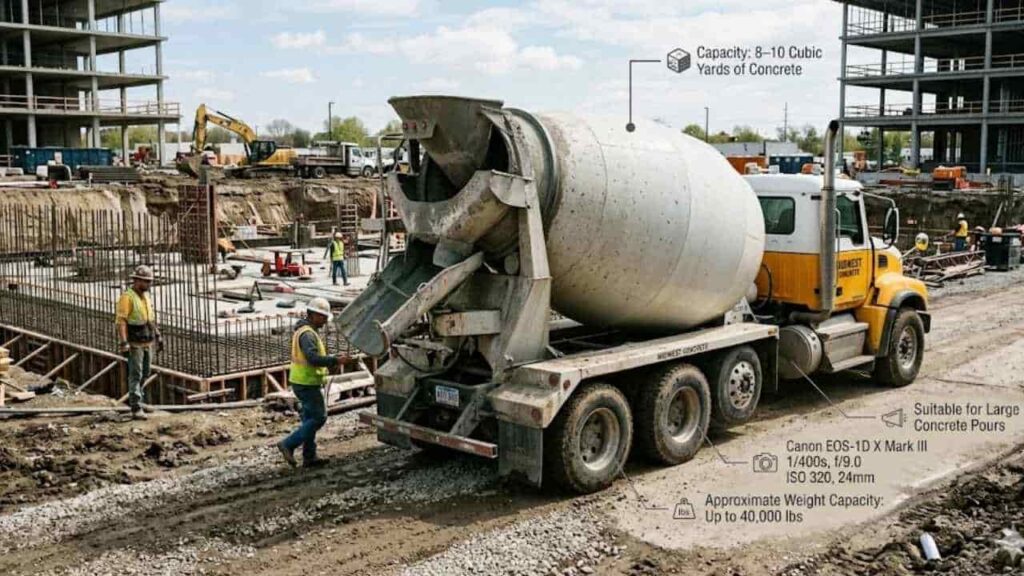
The mixer truck is not carried everywhere but it is used to mix concrete on a daily basis. Before going for a Mixer truck, it is important to calculate the amount of concrete that can be mixed within it. Generally, a mixer can easily carry 8-10 cubic yards at once. At least two rounds of mixer would blend the concrete. They are avoided at construction areas as they are extremely heavy and can not be taken everywhere. The floor might break due to its heavy weight.
A mixer truck itself can carry 40000 lbs of weight.
10 × 4000 = 40000 lbs.
How Much Does a Yard of Concrete Cover at Different Thicknesses?
Besides the amount of concrete required, the thickness of the concrete layer should also be considered. After mixing the concrete or carrying it somewhere else, builders or constructors usually decide on how thick the concrete layer should be on the floor. Considering the volume of 1 cubic yard is 27 cubic feet and the thick the layer is, the less area it will cover.
Here, I will elaborate in detail on how many yards of concrete can be spread in 4 inches, 6 inches and 12 inches of thickness.
1 Inch Vs 4 Inches
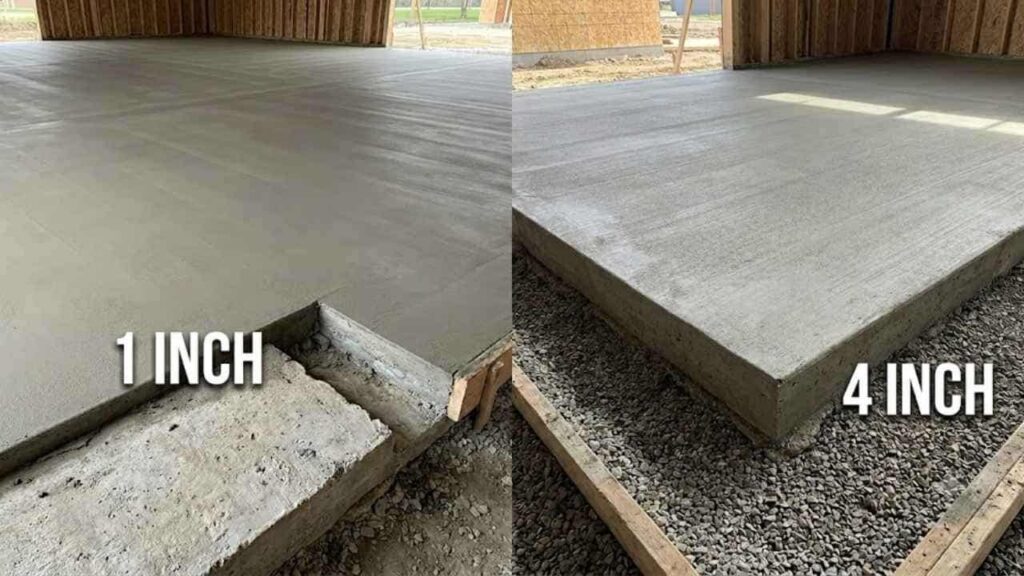
First of all, to calculate how big is a yard of concrete 4 inches thick, the volume should be multiplied with the coverage area.
Thickness in feet = 27 cubic feet × coverage area
When 1 inch of thickness is compared to 4 inches of thickness, it can roughly cover a room of 18ft × 18ft dimensions. This thickness is used only for toppings, repairs, and overlays. It is really thin for structural slabs or floors. On the other hand, in the case of 4 inches thickness, 4/12 = 0.333 ft / ⅓ ft approximately. That means dividing 27 by ⅓ would give you 81 square feet.
27 ÷ ⅓ = 81 square feet
The room or land of 81 square feet would require concrete for 9 ft × 9ft dimensions. It takes 4x more concrete to cover with a floor, wall, or slab.
1 Inch Vs 6 Inches
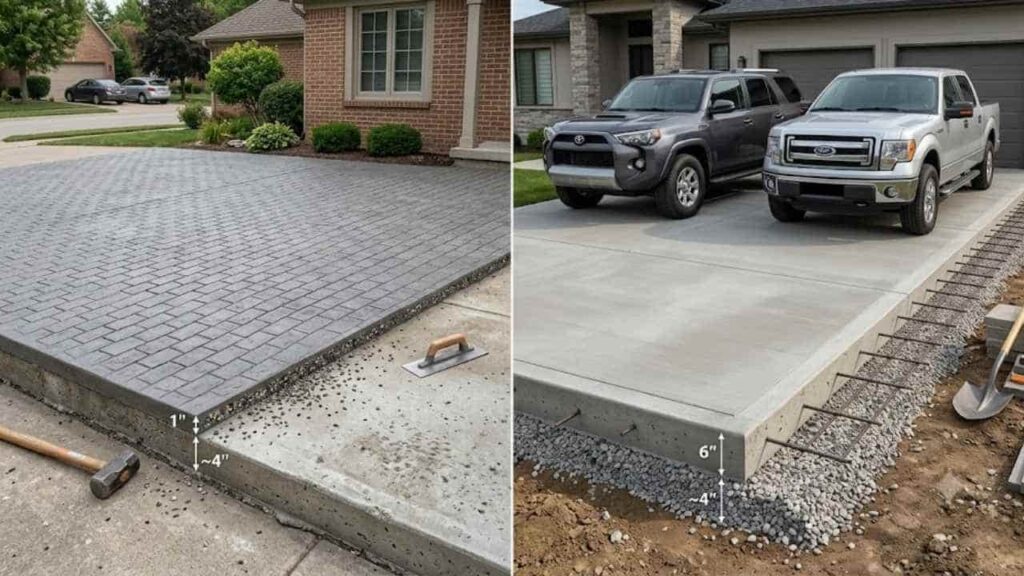
While applying a layer of 6 inches, it is also calculated how big is a yard of concrete 6 inches thick in feet for an accurate amount.
6/12 = ½ feet
Area of coverage = 27 ÷ ½ = 54 square feet.
This thickness of layering is considered more relevant for driveways, heavier loads, garages and light truck traffic. The pressure on the floor might break the concrete layer if it is thin. The amount of concrete used in one inch will be six times more than the usual.
| Basis | One Inch Thick | 4 Inches Thick | 6 Inches Thick |
| Thickness in feet / Coverage area | 0.083 Feet / 324 sq ft | 0.333 feet / 81 sq ft | 0.5 feet / 54 sq ft |
| Durability | Least | Good | High |
| Resistance to damage | Poor | Moderate | Highest |
| Expected lifespan | Short lifespan | Moderate lifespan | Longest lifespan |
| Best used for | Levelling, patching or decoration work | Sidewalks, patio floors, residential slabs | Driveways, garages, light truck traffic |
Where Is A Yard Of Concrete Used In?
Till now, we have understood how big a yard of concrete is, how much the weight is, and what thickness is best for usage in certain situations. The concrete is used for several purposes whether the concrete is for a yard only.
A yard is 27 cubic feet in volume that weighs 4000 pounds. It provides strength, durability, weather resistance and load support to wheelbarrow trucks or mixer trucks.
Sidewalks

Concrete layering is highly preferred for sidewalks in a standard thickness of 4 inches. It can easily handle the moderate weight but for higher traffic areas, 5-6 inches of thickness is appreciated. Concrete can resist different weather conditions, handle high foot traffic and stay stable despite pressure. It is relatively low-maintenance and can last for decades without much repair.
Patios

Patios are built on the exteriors and often require maintenance as they give the initial impression of the house. The concrete patios are considered more for high durability, no maintenance and handle furniture scratches and deep grills. Usually, the thickness is 4 inches, but if the patio is used for outdoor kitchens, then 5-6 inches of thickness is preferred.
Driveways

Considering how big a yard of concrete driveway is that handles the heavy traffic, it requires a higher amount of thickness to handle the weight. Concrete is put in a way that can handle cars, SUVs, trucks, and heavy loads. In residential areas, 4-6 inches for cars and small vehicles, and for heavy vehicles, 6-8+ inches.
Thin layers might crack, sink or create dents into the floor which makes the proper laying of concrete necessary. Sometimes rebar grids, wire meshes and fibre meshes are used as it creates tension within the concrete and keeps it strong by weight distribution.
Fence Posts

Concrete is the best material to solidify the fence posts. It stabilizes the poles, resists overturning and prevents movements. The amount of concrete to put in the holes depends on fence height, wind speed and the type of soil.
Sometimes the concrete can not handle the fence weight and fails. It is because the post is not deep enough, too little concrete is used or the drainage is poor. These reasons weaken the post and concrete bond.
Garage Floors

Garage floors usually handle the most weight and regular damage. Concrete is considered the strongest and most flexible material for floors with high traffic. 4 inches minimum and 5-6 inches at max is layered on the floor.
It requires a large amount of concrete but it provides strength, vapor barrier and reinforcement. Yet with these benefits, concrete has subgrade settlement, can crack or scale by the time and as it is porous, it leaves oil stains or certain damages.
Essential Tips To Consider Before Using Concrete
No matter how big a yard of concrete is, unless it is maintained, it will not last longer or endure physical damage. Concrete might look like an easy option but it requires a lot of steps for durability and strength.
It includes water content, timing, curing, finishing techniques and soil conditions, etc. Apart from these basic preparations, there are several other necessary things to do for a strong floor or wall.
Site Preparation
The most important step of using concrete on any floor is site preparation. Generally, the load is distributed downwards and if the soil is unprepared, it might break or crack over time.
However, the soil can potentially shift, compress, expand or even erode if not prepared. Without any preparation, the land can crack, lift or lay uneven without much use. First, evaluate the soil, fill dirt and excavate the topsoil for concrete.
Timing And Weather
Setting the concrete at the end is essential to building strength and providing durability to the structure.
Temperature, sunlight, humidity and rain highly impact the concrete setting. They can cause a chemical reaction that weakens the bond of concrete with the floor. These elements should be managed for a proper setting.
Extreme hot or cold weather is not considered good for concrete. Timing is another important thing along with the pouring sequence. The first layer should be laid within 60-90 minutes.
Material And Ordering
Ordering or sequence is as important as the quality of the material. However good the material is, if not poured in sequence, it might show early damage signs.
The concrete mix is made with cement, water, filtered sand and aggregate, but the proportions might change as per the requirements. After making the concrete mix, the PSI is calculated as it provides the strength.
The ordering of the concrete mix ingredients is also essential to conduct proper chemical reaction.
Safety and Labour
Working with concrete has certain health risks and requires physical strength. It can strain your body no matter how many bags of cement in a yard are needed. They weigh 4000 pounds in each bag.
While preparing the cement for concrete, it becomes highly basic due to the pH level. Wet concrete can irritate the skin and can cause chemical burns or severe dermatitis. It is advised to wear gloves, boots, long-sleeved clothes, respirators, and glasses for further safety.
Conclusion
At the end of the day, for a homeowner or a builder, understanding how big a yard of concrete is is important, as the accurate amount helps save on cost.
Since a yard is 27 cubic feet in volume it will carry 4000 pounds of weight that should be carefully laid on the floor. As it is used for several purposes such as driveways, patios and decorating layers, it offers strength and a clean finish to the surface with damage resistance.
This material is not just used blindly but the thickness of the concrete is necessary according to the purpose of the floor. People wonder how big a yard of concrete is, 4 inches thick, 6 inches thick or 12 inches thick. It affects the PSI of the floor, which strengthens the bond of cement and water.
In conclusion, the proper instructions and precautions should be taken carefully while working with concrete. Irrespective of how big a yard of concrete is, it can be used for driveways, alleys and pathways.
FAQs on How Big is a Yard of Concrete
Ans. Since one yard is equivalent to 27 cubic feet, that means 3 yards of concrete will be three times of 27 cubic feet which is 81 cubic feet. In terms of weight, 1 yard carries 4000 pounds, so 3 yards will carry 12000 pounds.
Ans. 10 yards of concrete is ten times 27 cubic feet, which results in 270 cubic feet. Nevertheless, In weight, it will be 10 times 4000 pounds, that is 40000 pounds.
Ans. In an 80lb bag of concrete, there will be 0.60 cubic feet. First of all, a yard carries 27 cubic feet of concrete that means 27 ÷ 0.60 = 45 bags of concrete.
Ans. It is ⅓ foot in 4 inches, and as it is divided by 27cubic feet, it gives 81 square feet at the end. It means one cubic yard concrete at 4 inches thickness will cover 81 square feet of area.
Ans. For a 20×20 slab, 400 square feet of concrete will be needed. The concrete calculation formula for this problem is length × breadth × height/27 = concrete in yards.